Install Bead 3
Add Bead 3 to your home screen for a full-screen, app-like experience — no browser bar, quick launch anytime.
Bead 3, also known as Three Guti, Three Bead, or Three Men's Morris, is a free online strategy board game from the Raxzen game collection. Inspired by the traditional Three Guti-style board game played across South Asia for generations, Bead 3 combines a simple set of rules with a carefully designed premium tabletop-style interface, smooth interactions, responsive controls, sound effects, and a modern browser-based experience.
The game is designed to be quick to understand but strategic enough to make every move matter. You can challenge the computer or play directly against a friend on the same device — no downloads, no accounts, no hassle.
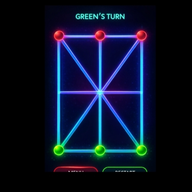
Each player controls three pieces on a connected 3×3 board with diagonal lines. The objective is to move your pieces strategically and create a winning line of three before your opponent does.
The classic board consists of 9 intersection points arranged in a 3×3 grid, connected by horizontal, vertical, and diagonal lines.
There are 8 possible winning lines: 3 horizontal rows, 3 vertical columns, and 2 diagonals.
Phase 1 — Placing Pieces (Placement Phase)
Phase 2 — Moving Pieces (Movement Phase)
The first player to successfully create a valid straight line of three pieces — horizontally, vertically, or diagonally — wins the round.
The game also includes a randomized first turn, so every new round can begin differently, adding variety and replay value.
Want to play alone? Choose "Vs Computer" and challenge the built-in AI opponent. The computer opponent can:
This provides a simple single-player experience while keeping the game lightweight and easy to start.
Bead 3 also includes a "Vs Friend" mode, allowing two people to play on the same device. No second account or separate device is required — simply hand the device to the other player and take turns. This makes it ideal for:
The visual design of Bead 3 is intentionally different from typical neon-style browser games. It uses a premium traditional tabletop aesthetic featuring:
The result is a more sophisticated board-game atmosphere while keeping the interface simple and easy to understand.
The game provides visual feedback throughout the entire experience. When interacting with the board, players can see:
Sound effects are also integrated into important interactions to make the experience feel more responsive and engaging.
Bead 3 is designed to work comfortably across different screen sizes. You can play on smartphones, tablets, laptops, and desktop computers. The board and controls are designed with touch interaction in mind, making the game suitable for mobile browsers as well as larger screens. No installation is required — just open your browser and start playing.
Bead 3 includes Progressive Web App (PWA) functionality. On supported browsers and devices, you can add the game to your home screen and use it with an app-like experience. This provides convenient access without requiring a conventional app-store installation.
The rules are straightforward, but winning requires planning. A good player needs to think about:
Because each player only has three pieces, every single move can have a meaningful impact on the result. The center of the board is especially valuable because it participates in four different winning lines (horizontal, vertical, and both diagonals), giving the player who controls it a significant strategic advantage.
Bead 3 is designed for quick rounds, making it easy to play again and again. After a round ends, players can immediately start another game and try a different strategy. You can switch between Vs Computer and Vs Friend modes whenever you want, keeping the experience fresh and engaging.
Bead 3 uses a premium, minimal, dark wooden game-board interface with a wood-and-brass theme — a clean, elegant, game-first design with realistic 3D pieces.
Top status bar: centered player labels "IVORY" and "COMPUTER," each shown with three small pieces representing remaining pieces on the board, set in simple spacing and uppercase typography that clearly shows both players and their progress.
Game board: a tall vertical rounded-rectangle board with a thick double gold/bronze outer border, a dark brown wooden background with a subtle diagonal wood-grain texture, and an inner border that creates a premium framed appearance around a large, uncluttered playing area.
Board layout: 9 playable points arranged in a 3×3 structure — three on the top row, three across the center, three on the bottom row — connected vertically between corresponding columns, horizontally across each row, and diagonally between the corners and the center, which acts as the main intersection point.
Pieces: Ivory pieces are glossy off-white/cream 3D spheres, while the opponent's pieces are glossy dark/black 3D spheres, each rendered with realistic gradients, highlights, shadows, and depth. Small circular gold markers frame the playable points on the board.
Visual palette: dark brown, antique gold, and ivory tones with soft shadows, subtle highlights, and a slight 3D depth effect create high contrast between pieces, board, and lines — with no clutter and no unnecessary buttons or decorations, for an overall feel that is premium, polished, and modern while preserving the traditional board-game identity.
Three Men's Morris belongs to one of the oldest families of board games in human history. It is an abstract strategy alignment game where two players each control three pieces and compete to form a straight line.
Three Men's Morris has been played under dozens of regional names for centuries. Below is an extensive (though still non-exhaustive) list of local names documented across cultures:
| Region / Country | Local Name | Language | Meaning |
|---|---|---|---|
| Philippines | Tapatan | Tagalog | Three in a row game |
| China | Luk Tsut K'i (六子棋) | Cantonese | "Six man chess" |
| China | Yih | Chinese | Early form of tic-tac-toe |
| India (Bengal) | Tant Fant (তাঁত ফাঁত) | Bengali | "Loom-foom" / weaving |
| India (Bengal) | Tin Guti (তিন গুটি) | Bengali | "Three pieces" |
| India (Bengal) | Tin Guti Pait Pait | Bengali | "Getting three pieces" |
| India (Hindi) | Teen Goti (तीन गोटी) | Hindi | "Three pieces" |
| India (Tamil) | Katta Vilaiyattu | Tamil | "Square game" |
| India (Malayalam) | Nira (നിര) | Malayalam | "Line" |
| India (Malayalam) | Padavettu | Malayalam | "Battle" |
| India (Malayalam) | Kallukali | Malayalam | "Stone game" |
| India (Tant Fant) | Tant Fant | Indian | Pieces start on sides |
| Ghana | Achi | Akan/Twi | "To come/arrive" |
| France | Marelle | French | Same game, adjacent moves |
| France | Le Jeu du Moulin | French | "The mill game" |
| Spain | Tres en Raya | Spanish | "Three in a line" |
| Spain | Castro | Spanish | "Fort" |
| Spain | Pedrería | Spanish | "Little stones" |
| Catalonia (Spain) | Marro | Catalan | Local variant |
| Ireland | Cashlan Gherra | Irish Gaelic | Recorded 17th century |
| Ireland (historical) | Nine Holes | English | Played on Isle of Man 1674 |
| Kenya | Shisima | Swahili | "Water" (water bugs) |
| Nigeria (Urhobo) | Epelle | Urhobo | Local name |
| Nigeria | Dara | Hausa/Yoruba | Three-in-a-row variant |
| Somalia | Jara-Badakh | Somali | "Reed game" |
| Madagascar | Fanorona Telo | Malagasy | "Three-Fanorona" |
| Arabic countries | Dris ath-Thalatha (دريس اثلاثة) | Arabic | "Three pieces game" |
| China (modern) | Cheng San Qi (成三棋) | Mandarin | "Achieving three game" |
| China (modern) | San Qi (三棋) | Mandarin | "Three game" |
| China (modern) | Lian Qi (連棋) | Mandarin | "Lining-up game" |
| China (modern) | Zhi Qi (直棋) | Mandarin | "Line game" |
| China (Teochew) | Dig Dig (直直) | Teochew | "Straight line" |
| Korea | Gonjil / Kon-tjil | Korean | Traditional name |
| Korea | Gono | Korean | Variant spelling |
| Germany | Mühle | German | "Mill" |
| Germany | Mühlespiel | German | "Mill game" |
| Germany | Neunstein | German | "Nine stone" (older form) |
| France | Mérelles | French | From Latin "merellus" |
| France | Jeu de Moulin | French | "Game of mill" |
| Spain | Morels | Spanish | Variant of merels |
| Italy | Smerelli / Linea | Italian | "Line" |
| Norway | Mølle | Norwegian | "Mill" |
| Sweden | Qvarn / Dubbel-qvarn | Swedish | "Mill / Double-mill" |
| Iceland | Mylna | Icelandic | "Mill" |
| Russia | Melnitsa / Melnichny | Russian | "Mill" |
| Hungary | Malomajatek | Hungarian | "Mill game" |
| Greece (Macedonia) | Triodi | Greek | "Trio" |
| Greece | Tò Triódi / Triódion | Greek | "Triodium" |
| India (Gujarati) | Nav Kakari | Gujarati | "Nine pieces" |
| India (Kannada) | Navakankari | Kannada | "Nine pieces" |
| India (Kannada) | Ombattu Kayiya Ata | Kannada | "Game of nine nuts" |
| India (Telugu) | Dadi | Telugu | "Attack" |
| India (Urdu) | Nau Guti | Urdu | "Nine pieces" |
| China (Mongolian) | Jirig / Jireg | Mongolian | From Chinese 吉日格 |
| Ottoman/Turkey | Dokuz Tas (طقوز طاش) | Turkish | "Nine stone" |
| Ottoman/Turkey | Dokurgin | Turkish | Related to nine |
| Switzerland | Nünischtei | Swiss German | Local dialect name |
| Romania | Moară | Romanian | "Mill" |
| Bulgaria | Dama | Bulgarian | "Checkers/draughts" |
| India (Sujjua) | Sujjua | Indian | Regional variant |
| Sri Lanka (Ceylon) | Nerenchi Keliya | Sinhala | "Nine pieces game" |
| China (Mono) | Yakamaido | Mono | "Square game" |
| Native American (Zuni) | Picaria | Zuni | "Little stones" |
| Native American (SW US) | Paritariya / Picarva / Pedreria | Various | Southwestern variants |
| South Africa | Morabaraba | Setswana | "To mill" - popular variant |
| Ancient Rome | Terni Lapilli | Latin | "Three pebbles" |
| Ancient Rome | Rota | Latin | "Wheel" (circular variant) |
| England (historical) | Merels / Merrills / Merelles | English | From Latin "merellus" |
| England (historical) | Ninepenny Marl | English | Historical variant |
| England (historical) | Cowboy Checkers | English | North American name |
| USA | Tic-Tac-Toe (variant) | English | Placement only version |
| Scotland | The Smaller Merels | English | Murray's term |
| New Mexico (Native) | Picaria | Native Amer. | With diagonal attachments |
A note on origins: some sources have proposed connections to ancient Egyptian boards at Kurna (~1400 BCE), but these claims remain disputed among historians, as do certain Roman and Chinese historical attributions. The most honest answer is that a single point of origin is not definitively known — alignment games of this type appear to have arisen independently, or spread through cultural exchange, across the Mediterranean, Europe, the Middle East, South Asia, Africa, and Southeast Asia over many centuries.
Because alignment games like this one are played under so many different names, here is how players in 100 countries — across every region and language group — might search for this style of game. This reflects the wide, cross-cultural reach of the Three Men's Morris family that Bead 3 belongs to.
| # | Country | Language(s) | Local Search Terms |
|---|---|---|---|
| 1 | United States | English | "three men's morris", "3 men's morris game", "nine holes board game", "tic tac toe with moving pieces" |
| 2 | Australia | English | "three men's morris", "3 men's morris", "tapatan game", "ancient strategy game 3 pieces" |
| 3 | Canada | English/French | "three men's morris", "3 men's morris", "jeu de moulin" (French Canada), "nine holes game" |
| 4 | United Kingdom | English | "three men's morris", "merels game", "nine holes", "smaller merels" |
| 5 | Ireland | English/Irish | "three men's morris", "cashlan gherra", "nine holes game", "ancient Irish board game" |
| 6 | New Zealand | English/Maori | "three men's morris", "3 men's morris", "strategy board game", "tapatan" |
| 7 | Switzerland | German/French/Italian | "Mühle spielen" (German), "Marelle jeu" (French), "gioco del mulino" (Italian), "three men's morris" |
| 8 | Norway | Norwegian | "Mølle spill", "three men's morris", "3 på rad spill", "strategi brettspill" |
| 9 | Denmark | Danish | "Mølle spil", "three men's morris", "strategi brætspil", "3 på stribe spil" |
| 10 | Sweden | Swedish | "Qvarn spel", "Dubbel-qvarn", "three men's morris", "Mölle spel" |
| 11 | Iceland | Icelandic | "Mylna leikur", "three men's morris", "3 í röð leikur", "strategía borðleikur" |
| 12 | Finland | Finnish/Swedish | "Mylly peli" (Finnish), "three men's morris", "3 riveissä peli", "strategia lautapeli" |
| 13 | Germany | German | "Mühle spielen", "Mühlespiel online", "three men's morris", "Neunstein Spiel" |
| 14 | Austria | German | "Mühle spielen", "Mühlespiel", "three men's morris", "Brettspiel Mühle" |
| 15 | Luxembourg | German/French | "Mühle spillen" (Lux German), "Marelle jeu" (French), "three men's morris", "3 Männer Morris" |
| 16 | Netherlands | Dutch | "Molenspel", "three men's morris", "3 op een rij spel", "strategisch bordspel" |
| 17 | Belgium | Dutch/French/German | "Molenspel" (Dutch), "Jeu de moulin" (French), "three men's morris", "Mühlespiel" (German) |
| 18 | France | French | "Marelle jeu", "Jeu du moulin", "Mérelles", "three men's morris" |
| 19 | Italy | Italian | "Smerelli gioco", "Linea gioco", "Gioco del mulino", "three men's morris" |
| 20 | Spain | Spanish | "Tres en raya con movimiento", "Juego de molino", "Morels juego", "three men's morris" |
| 21 | Portugal | Portuguese | "Jogo do moinho", "three men's morris", "3 em linha jogo", "jogo de estratégia tabuleiro" |
| 22 | Japan | Japanese | "スリー メンズ モリス" (surī menzu morisu), "3つの駒のゲーム" (3-tsu no koma no gēmu), "three men's morris", "三目並べ 移動版" (san-moku narabe - tic-tac-toe) |
| 23 | South Korea | Korean | "곤질" (gonjil), "고누" (gonu), "three men's morris", "3개 돌 게임" (3-gae dol geim) |
| 24 | Singapore | English/Chinese/Malay | "three men's morris", "成三棋" (cheng san qi), "permainan 3 batu" (Malay), "tapatan game" |
| 25 | Hong Kong | Cantonese/English | "直棋" (zhi qi), "luk tsut k'i", "three men's morris", "三棋" (saam kei) |
| 26 | Taiwan | Mandarin | "直棋" (zhi qi), "三棋" (san qi), "three men's morris", "成三棋" (cheng san qi) |
| 27 | United Arab Emirates | Arabic/English | "لعبة دريس" (l'ibat dris), "three men's morris", "لعبة 3 في صف" (3 in a row), "dris ath-thalatha" |
| 28 | Israel | Hebrew/English | "three men's morris", "משחק 3 בשורה" (mischak 3 be-shura), "משחק אסטרטגיה" (strategy game), "tic tac toe with movement" |
| 29 | Qatar | Arabic/English | "لعبة دريس", "three men's morris", "لعبة 3 في صف", "dris ath-thalatha" |
| 30 | Saudi Arabia | Arabic/English | "لعبة دريس", "three men's morris", "لعبة 3 في صف", "لعبة الطاحونة" (mill game) |
| 31 | Kuwait | Arabic/English | "لعبة دريس", "three men's morris", "لعبة 3 في صف", "dris ath-thalatha" |
| 32 | Bahrain | Arabic/English | "لعبة دريس", "three men's morris", "لعبة 3 في صف", "dris ath-thalatha" |
| 33 | Oman | Arabic/English | "لعبة دريس", "three men's morris", "لعبة 3 في صف", "dris ath-thalatha" |
| 34 | Czech Republic | Czech | "Mlyn hra", "three men's morris", "3 v řadě hra", "strategická desková hra" |
| 35 | Poland | Polish | "Młynek gra", "three men's morris", "3 w rzędzie gra", "gra strategiczna" |
| 36 | Slovakia | Slovak | "Mlyn hra", "three men's morris", "3 v rade hra", "strategická stolová hra" |
| 37 | Hungary | Hungarian | "Malomajatek", "Malom játék", "three men's morris", "3 sorban játék" |
| 38 | Lithuania | Lithuanian | "three men's morris", "Malūnas žaidimas", "3 eilėje žaidimas", "strateginis stalo žaidimas" |
| 39 | Latvia | Latvian | "three men's morris", "Dzirnavas spēle", "3 rindā spēle", "stratēģiskā galda spēle" |
| 40 | Estonia | Estonian | "three men's morris", "Veski mäng", "3 reas mäng", "strateegiline lauamäng" |
| 41 | Slovenia | Slovene | "three men's morris", "Mlin igra", "3 v vrsti igra", "strateška namizna igra" |
| 42 | Croatia | Croatian | "three men's morris", "Mlin igra", "3 u redu igra", "strategijska igra" |
| 43 | Romania | Romanian | "Moară joc", "three men's morris", "3 în linie joc", "joc strategic" |
| 44 | Bulgaria | Bulgarian | "Dama игра" (also used for checkers), "three men's morris", "3 в ред игра", "стратегическа игра" |
| 45 | Serbia | Serbian | "three men's morris", "Млин игра" (Mlin igra), "3 у низу игра", "стратегијска игра" |
| 46 | Bosnia & Herzegovina | Bosnian/Serbian/Croatian | "Mlin igra", "three men's morris", "3 u redu igra", "strategijska igra" |
| 47 | North Macedonia | Macedonian | "Triodi" (from Greek influence), "three men's morris", "3 во ред игра", "стратегиска игра" |
| 48 | Albania | Albanian | "three men's morris", "Loja e mullirit", "3 në rresht lojë", "lojë strategjike" |
| 49 | Greece | Greek | "Το Τριόδι" (To Triodi), "Τριώδιον" (Triodion), "three men's morris", "3 σε σειρά παιχνίδι" |
| 50 | Cyprus | Greek/Turkish/English | "Το Τριόδι" (Greek), "three men's morris", "3 σε σειρά παιχνίδι", "üç taş oyunu" (Turkish Cypriot) |
| 51 | India | Hindi/English + 22 official languages | "तीन गोटी" (teen goti), "three men's morris", "तंत फंत" (tant fant), "3 stones game India" |
| 52 | Pakistan | Urdu/English | "teen goti" (तीन गोटी), "three men's morris", "3 guti game", "teen pathar khel" |
| 53 | Bangladesh | Bengali/English | "তিন গুটি খেলা" (tin guti khela), "তাঁত ফাঁত" (tant fant), "three men's morris", "3 guti game" |
| 54 | Sri Lanka | Sinhala/Tamil/English | "Nerenchi Keliya" (Sinhala), "three men's morris", "3 stones game", "katta vilaiyattu" (Tamil) |
| 55 | Nepal | Nepali/English | "three men's morris", "tin goti khel", "3 stones game", "teen pathar khel" |
| 56 | China | Mandarin | "成三棋" (cheng san qi), "直棋" (zhi qi), "三棋" (san qi), "luk tsut k'i" |
| 57 | Mongolia | Mongolian | "Жирэг" (Jirig/Jireg), "three men's morris", "3 чулуу тоглоом", "стратегийн тоглоом" |
| 58 | Russia | Russian | "Мельница игра" (Melnitsa igra), "Мельничный" (Melnichny), "three men's morris", "3 в ряд игра" |
| 59 | Malaysia | Malay/English/Chinese | "three men's morris", "permainan 3 batu", "tapatan game", "3 dalam satu baris" |
| 60 | Indonesia | Indonesian | "three men's morris", "permainan 3 batu", "game 3 baris", "permainan strategi papan" |
| 61 | Thailand | Thai | "three men's morris", "เกม 3 หิน" (game 3 hin), "เกมวางแผน" (strategy game), "len choa" (leopard hunt - related traditional) |
| 62 | Philippines | Tagalog/English | "Tapatan", "Tapatan game", "three men's morris", "larong 3 sa isang hanay" |
| 63 | Vietnam | Vietnamese | "three men's morris", "trò chơi 3 hàng", "game 3 viên", "trò chơi chiến thuật" |
| 64 | Brazil | Portuguese | "Jogo do moinho", "three men's morris", "3 em linha jogo", "jogo de tabuleiro estratégia" |
| 65 | Mexico | Spanish | "Tres en raya con movimiento", "Juego de molino", "three men's morris", "juego de 3 piedras" |
| 66 | Chile | Spanish | "Tres en raya con movimiento", "three men's morris", "juego de molino", "3 en línea juego" |
| 67 | Argentina | Spanish | "Tres en raya con movimiento", "three men's morris", "juego de molino", "3 en línea juego" |
| 68 | Colombia | Spanish | "Tres en raya con movimiento", "three men's morris", "juego de molino", "3 en línea juego" |
| 69 | Peru | Spanish/Quechua | "Tres en raya con movimiento", "three men's morris", "juego de molino", "3 en línea juego" |
| 70 | Ecuador | Spanish | "Tres en raya con movimiento", "three men's morris", "juego de molino", "3 en línea juego" |
| 71 | Uruguay | Spanish | "Tres en raya con movimiento", "three men's morris", "juego de molino", "3 en línea juego" |
| 72 | Costa Rica | Spanish | "Tres en raya con movimiento", "three men's morris", "juego de molino", "3 en línea juego" |
| 73 | Panama | Spanish | "Tres en raya con movimiento", "three men's morris", "juego de molino", "3 en línea juego" |
| 74 | Dominican Republic | Spanish | "Tres en raya con movimiento", "three men's morris", "juego de molino", "3 en línea juego" |
| 75 | Guatemala | Spanish | "Tres en raya con movimiento", "three men's morris", "juego de molino", "3 en línea juego" |
| 76 | Bolivia | Spanish/Aymara/Quechua | "Tres en raya con movimiento", "three men's morris", "juego de molino", "3 en línea juego" |
| 77 | Paraguay | Spanish/Guarani | "Tres en raya con movimiento", "three men's morris", "juego de molino", "3 en línea juego" |
| 78 | El Salvador | Spanish | "Tres en raya con movimiento", "three men's morris", "juego de molino", "3 en línea juego" |
| 79 | Honduras | Spanish | "Tres en raya con movimiento", "three men's morris", "juego de molino", "3 en línea juego" |
| 80 | Jamaica | English/Jamaican Patois | "three men's morris", "3 in a row game", "tic tac toe with moving", "strategy board game" |
| 81 | Trinidad and Tobago | English | "three men's morris", "3 in a row game", "strategy board game", "tic tac toe with movement" |
| 82 | South Africa | English/Afrikaans/Zulu/Xhosa | "Morabaraba", "three men's morris", "3 in a row game", "mill game" |
| 83 | Nigeria | English/Hausa/Yoruba/Igbo | "Achi game" (related), "Dara game", "three men's morris", "Epelle" (Urhobo name) |
| 84 | Kenya | English/Swahili | "Shisima", "three men's morris", "3 in a row game", "mchezo wa mawe 3" |
| 85 | Ghana | English/Twi/Akan | "Achi game", "three men's morris", "3 in a row game", "traditional board game" |
| 86 | Morocco | Arabic/French/Berber | "three men's morris", "Dama" (also checkers), "لعبة 3 في صف", "jeu de 3 en ligne" |
| 87 | Egypt | Arabic/English | "three men's morris", "لعبة دريس", "لعبة 3 في صف", "ancient Egyptian board game" |
| 88 | Tunisia | Arabic/French | "three men's morris", "لعبة 3 في صف", "Dama" (checkers variant), "jeu de moulin" |
| 89 | Algeria | Arabic/French/Berber | "three men's morris", "لعبة 3 في صف", "Dama" (checkers), "jeu de moulin" |
| 90 | Jordan | Arabic/English | "three men's morris", "لعبة دريس", "لعبة 3 في صف", "dris ath-thalatha" |
| 91 | Lebanon | Arabic/French/English | "three men's morris", "لعبة دريس", "jeu de moulin", "لعبة 3 في صف" |
| 92 | Kazakhstan | Kazakh/Russian | "three men's morris", "Мельница игра" (Russian), "3 тас ойын" (Kazakh), "стратегиялық ойын" |
| 93 | Uzbekistan | Uzbek/Russian | "three men's morris", "Мельница игра" (Russian), "3 ta tosh o'yin" (Uzbek), "strategik o'yin" |
| 94 | Kyrgyzstan | Kyrgyz/Russian | "three men's morris", "Мельница игра" (Russian), "3 таш оюн" (Kyrgyz), "стратегиялык оюн" |
| 95 | Georgia | Georgian/Russian | "three men's morris", "სამი ქვის თამაში" (sami kvis tamashi), "стратегическая игра", "3 в ряд игра" |
| 96 | Armenia | Armenian/Russian | "three men's morris", "3 քարի խաղ" (3 kari khagh), "стратегическая игра", "3 в ряд игра" |
| 97 | Azerbaijan | Azerbaijani/Russian | "three men's morris", "3 daş oyunu" (Azerbaijani), "стратегическая игра", "3 в ряд игра" |
| 98 | Moldova | Romanian/Russian | "Moară joc" (Romanian), "Мельница игра" (Russian), "three men's morris", "3 în linie joc" |
| 99 | Ukraine | Ukrainian/Russian | "Мельница игра" (Russian), "three men's morris", "3 в ряд гра" (Ukrainian), "стратегічна гра" |
| 100 | Belarus | Belarusian/Russian | "Мельница игра" (Russian), "three men's morris", "3 у шэраг гульня" (Belarusian), "стратэгічная гульня" |
Alongside the country-specific terms above, closely related traditional games that players may search for include: Tic-Tac-Toe / Noughts and Crosses, Nine Men's Morris / Mill, Six Men's Morris, Twelve Men's Morris, Morabaraba (South Africa), Achi (Ghana), Tapatan (Philippines), Tant Fant (India), Shisima (Kenya), Dara (Nigeria), Tsoro Yematatu (Zimbabwe), Picaria (Native American), Rota / Terni Lapilli (Ancient Rome), Alquerque de Tres (Spain, historical), Luk Tsut K'i (China), Fanorona (Madagascar), and Mū Tōrere (New Zealand).
| Game | Pieces / Player | Main Objective | Capture? |
|---|---|---|---|
| Bead 3 / 3 Guti | 3 | 3 in a row | No |
| Tic-Tac-Toe | Marks | 3 in a row | No |
| Nine Men's Morris | 9 | Mills + capture | Yes |
| Sixteen Guti | 16 | Capture opponent | Yes |
| Checkers | Many | Capture + promote | Yes |
| Chess | 16 | Checkmate | Yes |
| Achi (Ghana) | 4 | 3 in a row | No |
| Shisima (Kenya) | 3 | 3 in a row (center) | No |
| Tapatan (Philippines) | 3 | 3 in a row | No |
vs. Tic-Tac-Toe: both share the "three in a row" concept, but Three Men's Morris is distinct because of its movement phase — after all pieces are placed, players continue by moving pieces along connected lines, adding a layer of dynamic strategy that Tic-Tac-Toe lacks.
vs. Sixteen Guti: despite the similar name, 3 Guti and 16 Guti are completely different games. Sixteen Guti uses a much larger board with 37 points, 16 pieces per player, and revolves around capturing opponent pieces by jumping over them. Three Guti has no capturing mechanic — the sole objective is alignment.
Control the center. The center intersection is the most powerful position on the board because it participates in four winning lines (horizontal, vertical, and both diagonals). Controlling it gives you the most flexibility.
Create a fork. Set up your pieces so your next move threatens two different winning lines at once. Your opponent can only block one, guaranteeing you a win on the following turn.
Block early. If your opponent has two pieces in a line with an empty third spot, block it immediately — one missed block can end the game.
Use corners strategically. Corner pieces can contribute to both a diagonal and a horizontal or vertical line, creating multiple threats later.
Avoid traps. Be careful not to move a piece into a position where your opponent can force a fork. Always look two moves ahead when possible.
First-move advantage. In some rule variations the first player has a slight mathematical advantage — some versions restrict the first move from the center to balance the game.
Different regions and digital implementations use slightly different rules. The two most common variations are:
Variant A — Classic (Adjacent Movement): pieces move only to directly connected adjacent empty points. This is the most widely recognized traditional version, and the one used in Bead 3 and most historical descriptions.
Variant B — Free Movement (Any Empty Point): after placement, pieces can move to any empty point on the board, not just adjacent ones. This is documented by historian H.J.R. Murray as "Nine Holes," and is less common but still valid in some implementations.
Bead 3 uses the Classic Adjacent Movement rules for an authentic traditional experience.
What is Bead 3?
Bead 3 is a free online version of the traditional Three Men's Morris board game. Two players each control three pieces and compete to form a straight line of three on a 3×3 connected board. You can play against the computer or with a friend on the same device.
Is Bead 3 the same as Tic-Tac-Toe?
Not exactly. While both games involve getting three in a row, Bead 3 has a movement phase where pieces can be moved after placement, making it more dynamic and strategic than standard Tic-Tac-Toe.
How do I win in Bead 3?
You win by being the first player to arrange all three of your pieces in a straight line — horizontally, vertically, or diagonally — on the board.
Can I play Bead 3 on my phone?
Yes. Bead 3 is fully responsive and works on smartphones, tablets, laptops, and desktop computers, and is designed with touch controls in mind.
Do I need to download anything to play?
No. Bead 3 runs entirely in your web browser. You can also add it to your home screen as a Progressive Web App (PWA) for quick access.
Can I play against a friend?
Yes. The "Vs Friend" mode lets two people take turns on the same device — no second account or separate device is needed.
Is there a computer opponent?
Yes. The "Vs Computer" mode features a built-in AI that detects legal moves, looks for winning opportunities, blocks your threats, and plays automatically.
How old is this game?
Games of this type have existed for many centuries across multiple civilizations. Documented evidence dates back to medieval Europe (13th century) and possibly ancient Rome. The exact origin isn't definitively known, but it's one of humanity's oldest board game families.
What are the different names for this game?
It's known as Three Men's Morris, Three Guti, Tin Guti, Tant Fant, Tapatan, Achi, Shisima, Marelle, Tres en Raya, and many other names across different countries and cultures.
Is 3 Guti the same as 16 Guti?
No. They're completely different games. 3 Guti uses 3 pieces per player on a small board with no capturing. 16 Guti (also called Sholo Guti) uses 16 pieces per player on a larger board with capture-by-jumping mechanics.
Can the game end in a draw?
Yes. If both players' pieces become stuck in positions where no winning line can be formed, the game can end in a draw or tie, depending on the specific rules being used.
Does the first player have an advantage?
In some rule variations the first player has a slight mathematical advantage. Some versions restrict the first move from the center to balance fairness.
What makes Bead 3 different from other online versions?
Bead 3 stands out with its premium tabletop aesthetic, smooth animations, sound effects, responsive design, PWA support, and the ability to play both against AI and locally with a friend — all without any downloads.
Is Bead 3 free to play?
Yes. Bead 3 is completely free to play in your browser.
Can I install Bead 3 on my home screen?
Yes. On supported browsers and devices, you can add Bead 3 to your home screen as a Progressive Web App for an app-like experience.
Bead 3 is one of several interactive games developed under the Raxzen ecosystem. The broader Raxzen game vision focuses on creating lightweight, accessible, visually polished browser games that people can quickly open and enjoy without unnecessary complexity.
Other Raxzen games include:
Together, these games form part of an expanding collection of free, accessible Raxzen browser experiences.
Choose your mode. Make your move. Build your line. Whether you want to challenge the computer or sit down with a friend for a quick strategy match, Bead 3 provides a clean, premium, and accessible way to enjoy a classic board-game concept directly from the web.
♟️ Bead 3 — Simple Rules. Smart Moves. Classic Strategy.
—
Add Bead 3 to your home screen for a full-screen, app-like experience — no browser bar, quick launch anytime.